Legal Process IS the punishment
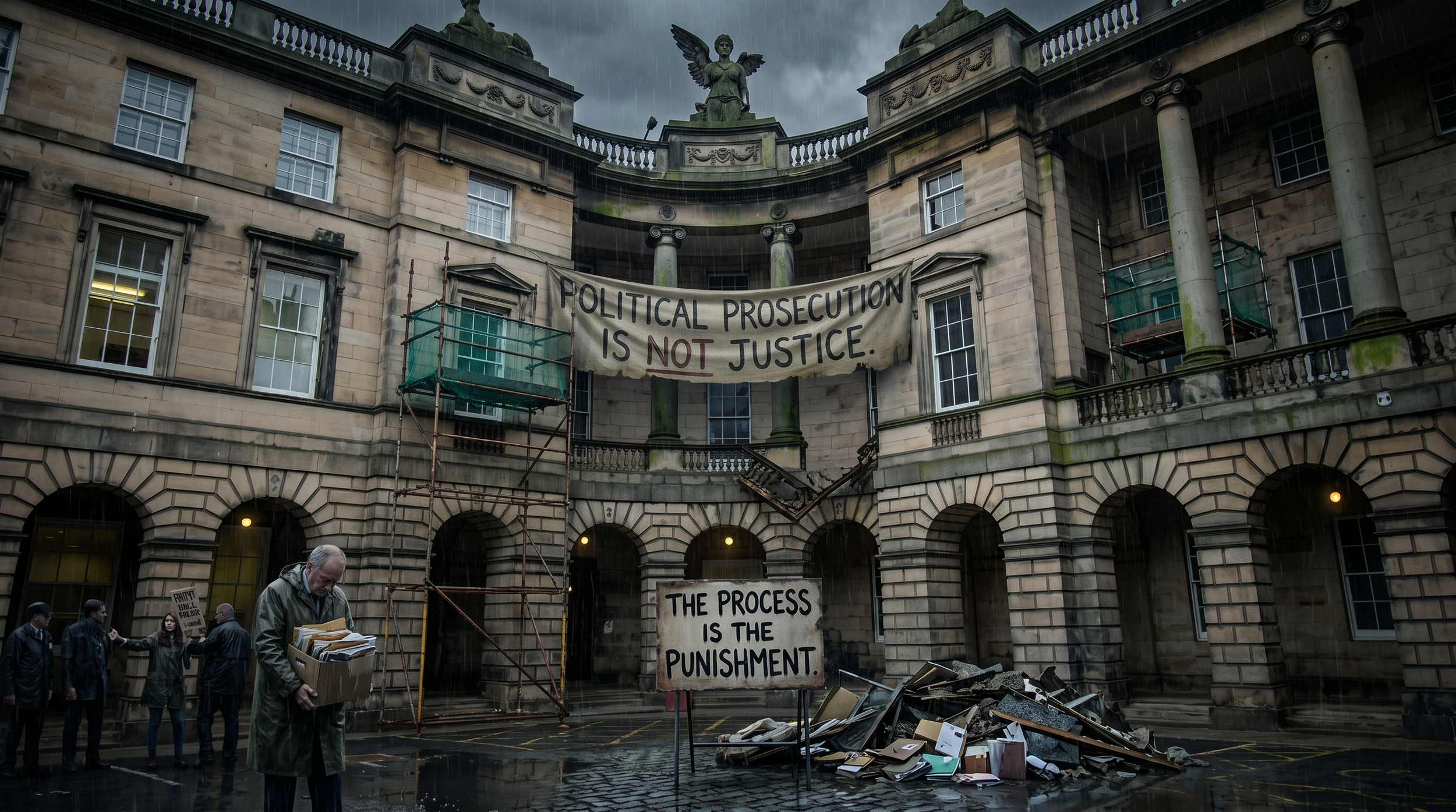
In February 2026 Lord Lake published his judgement in the action for malicious prosecution brought by Mark Hirst against the Lord Advocate and Chief Constable over the 2020 prosecution of Mr Hirst in the wake of the Alex Salmond trial.
In his February 2026 ruling Lord Lake of the Court of Session, who deliberated for nine months over the case, ruled that written declared statement of facts (averments) submitted by the Lord Advocate and Chief Constable that admitted they had “ulterior motive” for bringing the prosecution were indicative of malice and that the claimant, Mr Hirst, had a statable case to go before proof.
Lord Lake also concluded that “viewed objectively, there were no reasonable or probable grounds for bringing the case before any court”.
In March 2020 Mr Hirst, in the wake of the Alex Salmond trial that saw the former First Minister fully acquitted of all charges against him, recorded a video statement outlining his views of those behind the prosecution of Mr Salmond. The video was two minutes thirty eight seconds in length.
Consequently, Mr Hirst had his home raided by police and electronic devices taken and he was charged with a breach of the peace and sent for trial at Jedburgh Sheriff Court.
In January 2021 Sheriff Patterson, who presided over the case against Mr Hirst brought by the Crown, accepted a motion of “no case to answer”, adding “I do not accept [the comments made] would cause a reasonable person fear and alarm. The comments by the defendant were an expression of an opinion and nothing more.”
In Lord Lake’s (February 2026) judgement he concluded by highlighting the Lord Advocate’s immunity from any action arising against that position, whether it involved malice or not. This position meant that the case could not continue through the Scottish Courts. Lord Lake then went onto make a formal legal declaration that the provision of this immunity from any legal action brought against the Lord Advocate rendered Scots law incompatible with the European Convention for Human Rights, specifically Article 6 of ECHR. In other words it prevented a legal remedy against the Lord Advocate by any claimant and placed “an unjustifiable restriction on a pursuer’s right to have a determination of the merits of his claim that he was the subject of a malicious prosecution,” in the words of Lord Lake.
Although this judgement effectively ended Mr Hirst’s claim against Scotland’s most senior prosecutor, the Lord Advocate decided to appeal the decision to the Inner House of the Court of Session. A two day hearing then heard the Lord Advocate’s appeal before Lord Malcolm, Lord Armstrong and Lord Beckett.
Today (18th June 2026) those judges published their written judgement after two months of deliberation.
In the judgement by the Inner House of the Court of Session the three presiding judges (Lords Malcolm, Armstrong and Beckett) have, incredibly, upheld the appeal of the Lord Advocate. But they go much further in openly criticising both Lord Lake, following his nine month deliberation, and Sheriff Patterson who presided over the original criminal trial.
The Inner House decision also rejects the submissions to the Court, agreed by both the Lord Advocate and the Pursuer (Mr Hirst) and endorsed by Lord Lake, that the immunity of the Lord Advocate, as the law stands, renders Scots law incompatible with ECHR.
Responding to the ruling Mr Hirst said, “The stakes for the legal establishment in Scotland were always very high in this case as it has potentially huge implications for the entire Scottish legal system that even now may result in a new Scottish Criminal Justice Act being required.
“The Lord Advocate is now in the position where she argued in court that the provision that extends immunity for claims of malice against decisions by her prosecutors are a breach of Article 6 of ECHR. But this position has been rejected by the highest civil court in Scotland. The question for the Lord Advocate will be whether she will appeal this latest decision to the UK Supreme Court. If she does not, she is now on record as stating that that immunity renders Scots law incompatible with ECHR. That would be an incredible position for the Lord Advocate to allow to stand,” Mr Hirst said.
“We were conscious from the outset that we would be taking on the whole establishment, including the legal establishment, in pursuing this claim. We always knew that they would go to any lengths to find a way of denying accountability for what anyone with common sense can see was a political prosecution, pursued on behalf of the Scottish Government, of a political enemy. No amount of arcane legal waffling can obscure that obvious fact from anyone with the eyes to see it. The process was, and continues to be, the punishment. The Lord Advocate has gone to incredible lengths to put obstacles in our way to prevent us securing a proper legal remedy, on top of which has been the mounting associated court costs -- for example, the court itself charged me over £10,000 in fees for the Inner House hearing of the Lord Advocate’s appeal, a figure that I think would astonish most ordinary people who fondly imagine that access to our courts is free.” Mr Hirst added,. “Without the generous donations of thousands of ordinary people, it would not have been possible to continue.”
“The entire process has highlighted to me that the only prospect you can have of justice in Scotland is if you are exceptionally wealthy and even then justice is not assured,” he added.
“We will be studying the detail of this ruling over the course of the next few weeks and whether we will proceed ourselves with an appeal to the UK Supreme Court,” Mr Hirst said.
The full judgement of the Inner House of the Court of session can be found HERE.